
You’ve got a good team. They have grit and care about the quality of their work, but there just doesn’t seem to be enough time to address operational issues proactively.
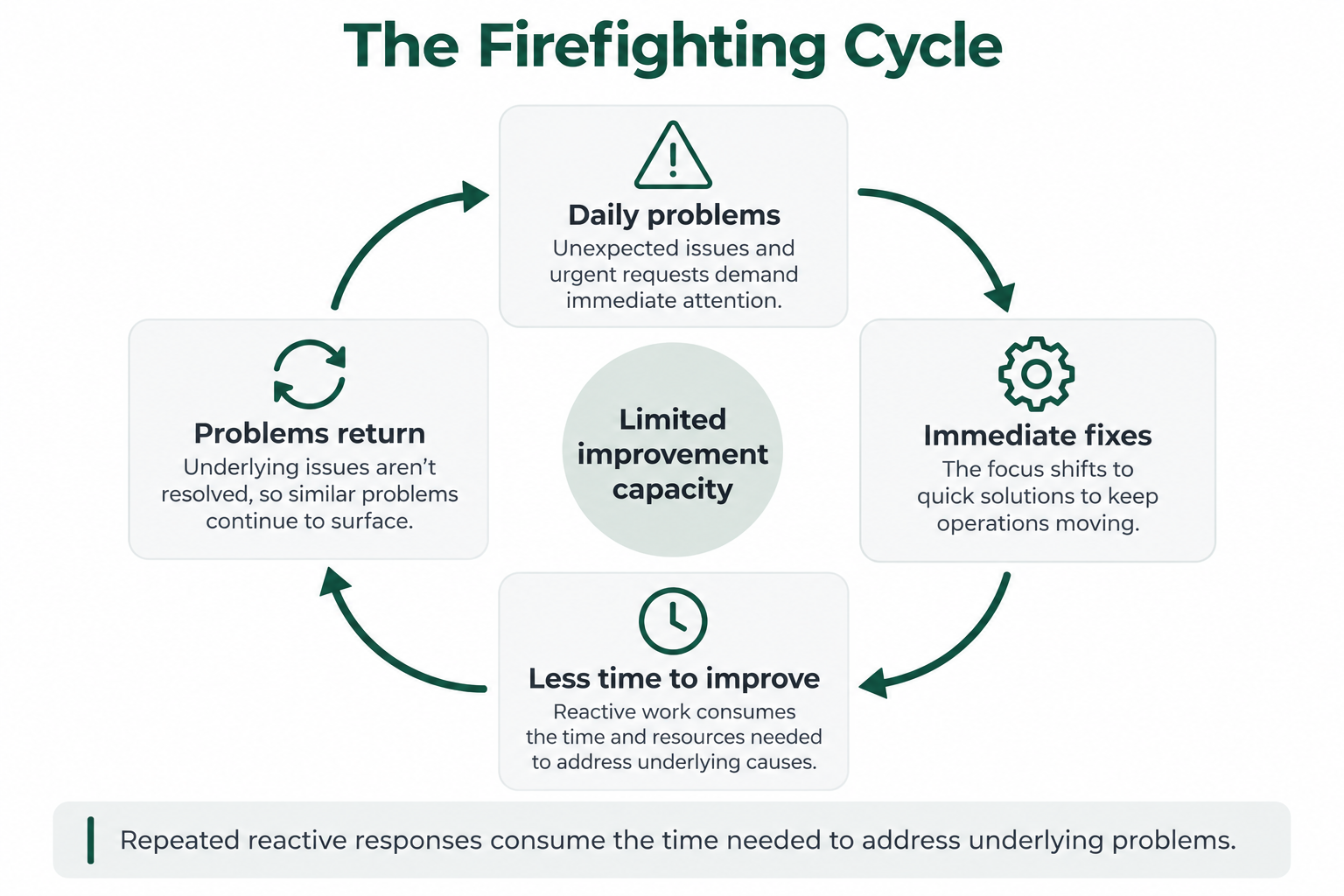
Firefighting today's problems has become a cycle that no one seems to be able to break. The business may be getting by, but complaints are on the rise, incidents in the field are increasing, and the team is burning out. Left unchecked, this cycle can lead to higher turnover and the gradual breakdown of processes once in place, further reinforcing a culture of constant firefighting.
When an operation reaches this point, building structure and introducing proactive processes and routines can feel insurmountable. The team may be less than enthusiastic about participating in change, not because they don't recognize the need for it, but because they can't imagine how it's possible within the demands of their current workday.
How does the pressure to get through today become the very thing preventing an operation from improving tomorrow?
How Firefighting Becomes the Way We Operate
It happens gradually. An unexpected issue here or there requires immediate attention. A deadline is pushed back or a team meeting is cancelled because a customer escalation takes priority and requires a quick resolution. The team takes action and is commended.
There’s nothing inherently wrong with responding to an urgent issue. The problem starts when it becomes a daily routine. While each decision may seem reasonable in the moment, collectively, they can create an operation so consumed by today’s demands that there’s little time to prevent the same problems tomorrow.
In their 2001 article, Nobody Ever Gets Credit for Fixing Problems That Never Happened: Creating and Sustaining Process Improvement, researchers Nelson Repenning and John Sterman describe a pattern they call the capability trap. When an organization is pressured to maintain performance, more time and resources are often devoted to immediate production, leaving less capacity to improve the processes and capabilities that support it. Over time, those capabilities can weaken, creating more problems and reinforcing the pressure to focus on immediate work.
This trap can be difficult to recognize when the team is still achieving short-term results. Customers are getting serviced, urgent issues are being addressed, and the operation appears to be meeting its immediate demands.
But at what expense?
Extra hours, workarounds, and people having to step in to save the day. Over time, this way of operating becomes difficult to sustain. If left unchecked, it can drive up operating costs, affect service reliability, and put customer relationships and revenue at risk.
When Urgency Starts Driving Leadership Decisions
Leaders are expected to respond when problems arise. The pressure is on to get answers, provide direction, and get the work done. Under that pressure, it can be easy to fall into a pattern of hurried decisions and shifting priorities, leaving employees to continually adjust.
Not every problem requires the same level of urgency, and not every hurried decision addresses why the problem occurred in the first place.
Consider an operation where customer complaints and missed services are increasing. Supervisors are repeatedly pulled away from planned responsibilities to investigate complaints, coordinate resolutions, and ensure customers receive their service. The immediate problems are addressed, but the same complaints continue to resurface.
What isn't being addressed is why the misses keep happening. Are there routing or dispatch issues? Are field employees receiving clear instructions and expectations? Without investigating the underlying causes and following through on corrective actions, the operation becomes dependent on responding to the same problems rather than preventing them.
I encountered this firsthand while overseeing a region experiencing repeated customer escalations. The manager would report an issue as resolved, only for it to resurface. When I investigated further and worked through the issues with the manager, we identified several underlying causes: unclear field expectations, missing account-specific service instructions, poorly maintained routes that created unnecessary drive time and missed service windows, employees relying on memory instead of their onboard routing systems, and inconsistent supervisory follow-through.
We developed a shared escalation tracker and corrective action plan, reorganized the routes, clarified service instructions and expectations, and established escalation responsibilities. But implementing those changes wasn't the end of the work. I continued supporting the manager through weekly reviews and quality checks to verify that corrective actions were being followed and to help establish a routine the manager could sustain independently.
Over time, customer escalations declined, and a major customer who had been particularly affected provided positive feedback about the consistent improvement in service they were receiving.
What this reinforced for me is that resolving an escalation and correcting the conditions behind it are two different responsibilities. Both require attention, but addressing the underlying causes can reduce the likelihood of the same problems returning.
As leaders, we can inadvertently reinforce the firefighting mentality while overlooking efforts to prevent recurring problems. The message about what matters most becomes clear, whether intended or not.
In her 1999 study, The Time Famine: Toward a Sociology of Work Time, Leslie Perlow examined how workplace behaviors contributed to a constant sense of urgency within a software engineering team. She found that 95% of observed workplace interactions occurred spontaneously. Only 10% were considered urgent, and 86% could have been scheduled for later without negative consequences. Despite this, frequent interruptions, a crisis-driven mentality, and recognition of employees who stepped in to save the day reinforced a cycle in which planned work was continually postponed.
When the team designated periods for uninterrupted work and coordinated interactions, engineers reported improvements in productivity. However, those changes were difficult to sustain. When Perlow returned months later, she found that the team had largely reverted to its previous work patterns.
This underlying challenge is relevant to service operations. When urgent demands consistently interrupt planned work, the team has less opportunity to address the conditions creating those demands.
The challenge is finding a balance between responding quickly when necessary and making time to prevent the same problems from happening again.
Creating Room for Proactive Operations
You’ve recognized the cycle, but how do you break it? The operation must go on, with service to perform, employees to support, and daily responsibilities that require your attention. This can feel overwhelming when the team is already stretched thin.
Creating room for improvement starts with being more intentional about how we manage our time, priorities, and responsibilities. It also means being realistic about how long improvement will take. Putting additional pressure on yourself and the team to fix everything immediately only reinforces the cycle you're trying to break. Improvement takes thoughtful decisions, consistent action, and follow-through.
These aren't unfamiliar concepts to most experienced operators. The challenge isn't necessarily knowing what needs to be done, but making the intentional decisions, committing the time, and following through consistently enough to make improvements stick.
Start with a few practical steps:
Distinguish what is truly urgent. Not every problem, request, or update requires an immediate response. Establish clear response criteria, supported by a simple priority matrix, to help employees determine what needs attention now, what can wait, and how to prioritize without compromising service or safety.
Investigate recurring issues. Prioritize problems that repeatedly surface, create significant risk, or consume disproportionate time and resources. A recurring-issue log can help identify patterns, while listening to employees closest to the work and acting on their observations can help uncover underlying causes and determine what needs to change.
Establish clear ownership and escalation guidelines. Not every issue requires everyone's involvement. Employees should understand what they can resolve independently, their decision-making authority, and when to escalate an issue. An ownership and escalation matrix can clarify responsibilities, identify when additional authority or support is needed, and prevent unnecessary interruptions. Ownership also includes following through on recurring problems.
Create and protect time for improvement. Examine where the team's time is going. Recurring escalations, unnecessary approvals, duplicated work, and unproductive meetings can consume valuable capacity. Identify what can be eliminated, simplified, or delegated. Where resources are insufficient, leadership may need to adjust priorities or provide additional support. Start with one recurring problem, dedicate time to addressing its causes, and verify that corrective actions are working. As recurring issues decline, redirect some of that recovered time toward further improvements.
Improvement requires an investment of time, and the benefits aren't always immediate. As Repenning and Sterman (2001) explain, this creates a difficult trade-off when today's operational demands are already consuming the time needed to make those improvements.
Employee recognition also matters. The person who steps in to resolve an urgent issue deserves recognition, but so does the person investigating its root cause and helping prevent it from happening again. Both contribute to the operation, but prevention can reduce the need for the same urgent response in the future.
The work required to improve tomorrow’s operation has to become part of how today is managed.
From Reactive Response to Proactive Leadership
Effective operational leadership isn’t measured by how many problems a manager can personally resolve in a day. What matters more is whether the operation is becoming better equipped to function without constant intervention or unnecessary demands on its people and resources.
That requires looking beyond immediate results, recognizing recurring patterns, and making time for improvements that may not produce an immediate payoff. It also means recognizing that accountability goes both ways. Employees are responsible for meeting expectations, but leaders must also examine whether the processes, systems, communication, and resources supporting those expectations are effective.
Unexpected problems will always be part of running an operation. Responding to them is necessary, but firefighting shouldn't become the primary way we operate. Moving toward a more proactive operation requires more than recognizing the cycle or identifying opportunities for improvement. It requires putting changes into practice, supporting the people responsible for carrying them out, and following through long enough to determine what's working and what still needs attention.
References
Perlow, L. A. (1999). The time famine: Toward a sociology of work time. Administrative Science Quarterly, 44(1), 57–81. https://doi.org/10.2307/2667031
Repenning, N. P., & Sterman, J. D. (2001). Nobody ever gets credit for fixing problems that never happened: Creating and sustaining process improvement. California Management Review, 43(4), 64–88. https://doi.org/10.2307/41166101
About Keturah Brumfield
Keturah is the founder of IronLine and an operations implementation leader with more than 20 years of experience across complex, regulated, and multi-site organizations. Her background in operations and psychology informs her approach to improving how people, processes, technology, and performance work together.
